Welcome to the Justice League of Greater Lansing Michigan (JLGLM) timeline. This document traces the organization’s development from its founding in 2021 through its major reparations milestones. It presents an evidence-based record of JLGLM’s partnerships, congregational commitments, financial investments, scholarship distributions, homebuilding projects, public education efforts, regional collaborations, and expanding community impact. It orients readers to JLGLM’s mission and shows how faith-based reparations in Greater Lansing have grown through sustained, locally governed commitments.
Founding Leadership
The founding leadership brings deep personal and professional grounding in justice work.
Ms. Willye Bryan
Ms. Willye Bryan grew up in the segregated South, where early exposure to racial inequality shaped her commitment to justice and community repair. Before founding the Justice League of Greater Lansing Michigan, she built a four-decade career as a classical biological control entomologist, serving with both the U.S. Department of Agriculture–Agricultural Research Service (USDA-ARS) and Michigan State University. Her scientific accomplishments include more than 35 peer-reviewed publications, contributions to invasive-species management, and co-editing Memoirs of Black Entomologists (JLGLM, n.d.-e).
At USDA-ARS, she organized the agency’s first Black History programs in the Mid-South region, advancing internal diversity and historical awareness. Alongside her research, she taught, mentored emerging scientists, and led community education initiatives connecting science, equity, and public service. Drawing on her civil-rights activism, scientific leadership, and decades of outreach, Ms. Bryan founded JLGLM in 2021 to address racial wealth inequities through a faith based reparations model focusing on education, homeownership, and business development under an African American Advisory Council.

Mr. Prince Jerold Solace
Mr. Prince Jerold Solace, president and co-founder of JLGLM, is a Lansing native. His professional work has included developing cross-cultural communication frameworks, and guiding institutions in understanding how historical racial harm shapes present-day outcomes. This communications and systems-change expertise shaped JLGLM’s public education strategy, media presence, and regional partnerships. Solace’s leadership frames reparations as a relationship-centered, faith-rooted practice, positioning JLGLM as a regional model for community-based repair and long-term wealth-equity initiatives. He has represented the League in state and regional media, coordinated multi-congregational partnerships, and led JLGLM’s scholarship program and public forums.

JLGLM is governed by an African American Advisory Council composed of community leaders from multiple sectors who oversee all reparations distributions.
Reparations Framework: Three Pillars
In 2021, the Advisory Council adopted a three-pillar reparations framework designed to address specific, historically produced barriers to wealth for African Americans:
1. Educational scholarships
Addressing their exclusion from federal education benefits, segregated and underfunded schools and persistent literacy and college-access disparities.
2. Homeownership
Responding to Black-white homeownership inequity in light of the national disparity data: Black home ownership at 43.9% versus 65.7% for other groups.
3. Business Entrepreneurship
Countering barriers caused by discriminatory lending, exclusion from postwar federal wealth programs and lack of start up capital.
These pillars specifically address documented wealth barriers: segregated schools and unequal GI Bill access (education), redlining and mortgage discrimination (homeownership), and credit discrimination and exclusion from federal capital programs (entrepreneurship). The Advisory Council’s oversight links each investment to specific, historically grounded harms and a descendant-focused reparations logic.
Chronological Development
2021–2025
October 2022
Justice League Receives Local Media Attention
In October 2022, the Lansing State Journal published a front page article describing the organization’s mission, leadership, and some early financial contributions from area churches.
“Education about reparations won’t stop when we hit our $1 million goal. We will continue to teach congregations about slavery, religion’s participation in racism, and the need for repair.”
(Lansing State Journal, 2022)


First Public Presentation
(Rev. Jimmie R. Hawkins)
JLGLM delivered its first formal public presentation in partnership with Rev. Jimmie R. Hawkins, Director of the Presbyterian Church (USA) Office of Public Witness. On October 14, 2022, JLGLM hosted a book discussion and signing for Unbroken and Unbowed: The History of Black Protest in America at Socialight Society, a Black-owned bookstore in Lansing. On October 15, 2022, Rev. Hawkins led a public discussion and book signing at the Downtown Capital Area District Library. These events marked JLGLM’s first community-facing introduction of its reparations framework and explicitly linked the local model to national scholarship on Black protest, public witness, and faith-based justice work.
January 2023
Apology at Lansing Reachout Christian Center
JLGLM coordinated a public apology and reparations event at the Lansing Reachout Christian Center, a predominately African American house of worship located on the southside of Lansing, aligning a liturgy of repentance with a call for structural action (JLGLM, 2023). Organizers prioritized visibility, interfaith participation, and media access, signaling a shift from internal congregational work to civic-focused public witness.
“An apology frees and liberates both groups. It frees White people from any guilt. And when you get rid of the guilt, then you’re ready to work and improve this society.”

April 2023

First Presbyterian Church of Holt
First Presbyterian Church of Holt chooses to participate in the work of reparations as an expression of faith, repentance, and hope. Acknowledging the ongoing harm caused by racial injustice, the church pledged $20,000 to support the Justice League’s efforts, trusting that this commitment will help advance healing, equity, and restorative justice in our community.
May 2023
Quaker Meeting in Lansing Joins
Red Cedar Friends Meeting (Quakers) made a payment of $7000 at the end of its fiscal year in hopes of continuing such payments annually.

June 19–20, 2023

Second Public Apology at the Capitol (Juneteenth)
Dozens of faith leaders and community members gathered on the Capitol lawn to deliver a formal apology for slavery based on the PC(USA) litany of repentance. WKAR’s Colin Jackson reported participation from faith communities across the Lansing region (Jackson, 2023). State Senator Sarah Anthony, whose district includes Lansing, welcomed and encouraged those gathered.
“This work is about repair. It is not charity, it is a moral response to a historic harm.”
(Justice League public remarks)
August 2023
Edgewood United Church Contributes
“As part of our call to practice reparations, our congregation on June 11th voted unanimously to contribute $100,000 of congregational endowment to the Justice League of Greater Lansing Michigan as repentance and repair for the historical damage of slavery and its aftermath". In addition to the congregational contribution, a number of individuals from Edgewood and beyond contributed from their personal resources. Total reparation payment, $173,260”.


All Saints Episcopal Church Contributes
All Saints Episcopal Church in East Lansing presented $130,470.62 to JLGLM, one of the League’s largest single congregational gifts. The presentation occurred in the church sanctuary, where clergy and parishioners delivered the check to Ms. Bryan and President Solace.
September 2023
Coalition Growth and Press Attention
Regional media described JLGLM’s trajectory from 2021 conception to a maturing multi-church fund structure. The Lansing City Pulse referred to JLGLM as “Lansing’s real Justice League,” and The Chronicle News emphasized that acknowledgment of harm was being followed by tangible repair (The Chronicle News, 2023; Lansing City Pulse, 2023).

October 2023

Local United Nations Association Honors Ms. Bryan
The United Nations Association–USA, Greater Lansing Chapter honored Ms. Bryan as a “2023 Global Goals – Local Leader” during its UN Day celebration. The award linked JLGLM’s faith-based reparations model to UN Sustainable Development Goals including No Poverty, Quality Education, Reduced Inequalities, and Peace, Justice & Strong Institutions. Regional reporting documented the ceremony and highlighted Bryan’s leadership.
“My life has been shaped by segregation. That history shaped my commitment to stand in the breach and insist on repair.”
(WILX, 2024)
November 2023
Recognition in the Congressional Record
U.S. Representative Elissa Slotkin issued a formal commendation recognizing JLGLM’s reparations work. The statement was entered into the Congressional Record on November 2, 2023, marking the first national-level acknowledgment of JLGLM’s model. Slotkin noted the League’s leadership in faith-based reparations, its community partnerships, and its impact on racial equity efforts in mid-Michigan.
Second Fall Celebration
JLGLM held its second annual Fall Celebration at Gregory’s soul food restaurant. The program highlighted the milestones achieved and impact made during the organization’s first two years of operating.
December 2023
Reparations Monday Recognition
JLGLM recognized “Reparations Monday” as a dedicated giving day focused on advancing Black-led reparative justice efforts. The Chronicle News reported that JLGLM had raised over $350,000 since its founding. (The Chronicle News, 2023).

January 2024

Audience of Nearly 100 Gathers for The Cost of Inheritance Film Screening and Panel Q&A
The discussion panel included Dr. Pero Dagbovie, associate provost for Graduate and Postdoctoral Studies and dean of the Graduate School; Dr. Jerlando F. L. Jackson, Dean and MSU Research Foundation professor of Education; Willye Bryan, founder of The Justice League of Greater Lansing; Prince-Jerold Solace, director of Congregational Life and Community Outreach at Lansing First Presbyterian Church; and Kit Carlson, pastor of All Saints Episcopal Church
February 2024
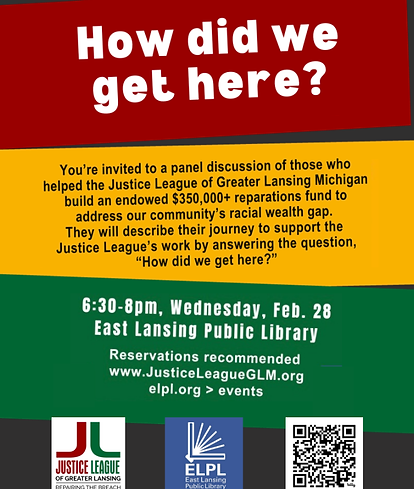
How Did We Get Here? Part I
The first annual “How Did We Get Here?” panel at the East Lansing Public Library, organized by the Justice League of Greater Lansing and moderated by Prince Jerold Solace, launched a community dialogue on local reparations and the racial wealth gap.
The event highlighted faith-based partnerships with local churches and led to the creation of a $350,000+ endowment to support economic justice initiatives.
March 2024
The Unity Spiritual Center of Lansing makes a reparations contribution to the Justice League of Greater Lansing, Michigan.

April 2024


Mandela Washington Fellowship
Mandela Washington Fellowship Collaboration and State Proclamation
JLGLM collaborated with the Mandela Washington Fellowship (MWF), a U.S. Department of State program for emerging African leaders hosted at Michigan State University. Fellows in the civic-engagement institute worked directly with President Solace and produced a congratulatory video honoring JLGLM’s inaugural scholarship recipients.
“Working with Prince Solace and the Justice League enriched our civic engagement institute and helped secure a proclamation from Governor Whitmer.”
(Mandela Washington Fellow, 2024)
August 2024
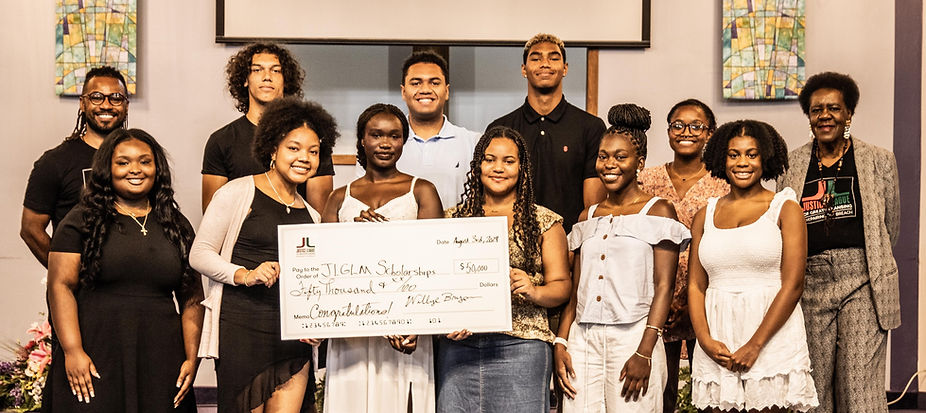
First Reparations Scholarship Disbursement
JLGLM issued its first reparations-funded scholarships in mid-2024, drawing from a community fund that had surpassed $400,000 since 2021 (Saliby, 2024a). Ten African American graduates each received $5,000, based on their essays on the racial wealth gap, formal interviews, and verified enrollment (Saliby, 2024a).
“We aren’t giving $5,000 scholarships to every child of color in America, but we’ve made a start. We have affected this community.”
(Saliby, 2024a)

The ceremony recognizing the scholarship recipients at Lansing Church of God in Christ brought together students, families, clergy, and JLGLM leadership (DuFort Petty, 2024).
September 2024

Unitarian Universalist Church of Greater Lansing
UUCGL has actively contributed to the JLGL's endowment through special plate collections and its Reparations Team, viewing it as a tangible way to "repair the breach" caused by historical racism, aligning with UU principles.
Total Reparation payment, $86,134.50
November 2024
3rd Fall Annual Celebration
JLGLM held its third annual Fall Celebration at MSU Federal Credit Union headquarters, highlighting three years of fund growth, interfaith coalition building, and program delivery.
“Reparations are not merely financial, they are spiritual, communal acts of restoration.”
(Rev. Jihyun Oh, 2024 Fall Celebration)

December 2024
Reparations Monday and Public Education
WILX’s DeAnna Giles reported JLGLM’s year-over-year progress, highlighting the $50,000 in scholarships and previewing the art exhibit titled Farmland: Food, Justice, and Sovereignty hosted by the Eli and Edyth Broad Art museum.
February 2025

Reparations in Art and Public Discourse
The Eli and Edythe Broad Art Museum at Michigan State University opened an exhibition titled Farmland: Food, Justice and Sovereignty which integrated JLGLM’s historical framing with contemporary visual art (WKAR, 2025a). Assistant Curator, Dalina A. Perdomo Álvarez expressed that
“This has been one of the most meaningful partnerships in my time at the MSU Broad Art Museum. It serves as a testament to what museums and community organizations can achieve through collaboration.”
(Dalina A. Perdomo Álvarez, Assistant Curator)
April 2025
First Home Build: Asset-Based Reparations
JLGLM, in partnership with the Eastside Community Action Center, supported the construction of a home for a senior African American first-time homebuyer on McCullough Street. Nearly $70,000 in JLGLM reparations funds supported construction, while Eastside Community Action Center provided homeowner training, savings support, and transition guidance (WKAR, 2025b).
“Home ownership is possible for individuals who sincerely desire it and work toward it. The Justice League’s support helped make this first build a reality.”
(Dr. Stan Parker, ECAC, 2025)

June 2025

Regional Juneteenth Collaboration (Flint)
JLGLM hosted a community session at Flint’s 53rd Annual Traditional Juneteenth Celebration, extending its educational reach beyond Greater Lansing while keeping faith-based reparations at the center of its message. The event strengthened regional networks and reinforced JLGLM’s role in statewide reparations conversations.
July 2025
Justice League of Greater Kalamazoo Established
The first replication of the JLGLM model emerged in Kalamazoo, Michigan, where organizers formally launched the Justice League of Greater Kalamazoo after extensive preparatory meetings with JLGLM leadership. This became the first confirmed regional adoption of Lansing’s faith-based reparations structure, including Black Advisory Council governance and the three pillars of scholarships, homeownership, and business development. It provided a concrete marker of JLGLM’s influence beyond its home region.
“This is a movement grounded in faith and accountability. Lansing can become a national model for reparative work.”
(Media remarks)

August 2025

Second Scholarship Cohort
JLGLM awarded its second cohort of 10 African American students reparations-funded scholarships of $2,500 each, for a total of $25,000. As with the first cohort, recipients were chosen based on their essays on the racial wealth gap, formal interviews, and verified enrollment.
“Creating a platform where students could speak about the realities of intergenerational wealth gaps was very, very powerful.”
(Saliby, 2024a)
September 2025
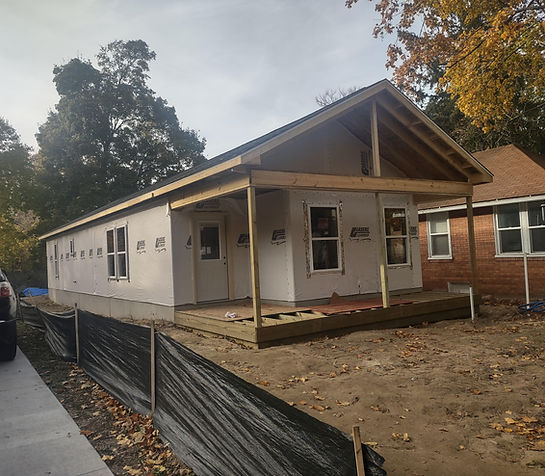
Second Home Build
JLGLM advanced its homeownership pillar with a second reparations-supported home on McCullough Street, adjacent to the first home. Construction was well underway at the end of the year. Funding followed the established model in which approximately $70,000 in JLGLM reparations dollars supported construction in partnership with the Eastside Community Action Center (ECAC) that again managed homeowner preparation and building coordination.
November 2025

Fourth Anniversary Fall Celebration (MSUFCU)
JLGLM’s Fourth Anniversary Fall Celebration took place at the MSU Federal Credit Union headquarters. Moderated by WKAR’s Sophia Saliby and featuring JLGLM historian and board member Dr. Nakia Parker, the event offered a four-year overview of fund development, scholarship awards, housing investments, coalition growth, and forward strategy for education, housing, and entrepreneurship.
University United Methodist Church announces a $100,000 pledge to the Justice League’s Reparations Fund, to be fulfilled through a multi-year matching campaign supported by congregational giving and endowment funds. The commitment reflects the church’s sustained support for reparative justice.

2026 and Beyond:
Ripple Effects and Forward Trajectory

Building on four years of structured reparations work—congregational funding, scholarship and homeownership programs, institutional partnerships, and national recognition—the Justice League of Greater Lansing Michigan has become a replicable model for faith-based repair. Its leadership, governance structure, and documented outcomes informed the launch of the Justice League of Greater Kalamazoo and guided exploratory efforts in Grand Rapids, MI, New Orleans, LA, and Greensboro, NC. As JLGLM moves forward, its expanding network, disciplined Advisory Council governance, and accumulated operational capacity position the organization to deepen its regional impact and support additional communities seeking to implement descendant-led, accountability-based reparations frameworks.
February 2026

How Did We Get Here? Part II
The “How Did We Get Here?" panel series began in 2024 at the East Lansing Public Library, where the Justice League of Greater Lansing, led by Prince Jerold Solace, launched a conversation on local reparations and the racial wealth gap, establishing a $350,000+ faith-based endowment.
In 2026, Part II at the Delta Township District Library expanded church partnerships and grew the initiative’s endowment to over $500,000.
StablesCommunities Foundation
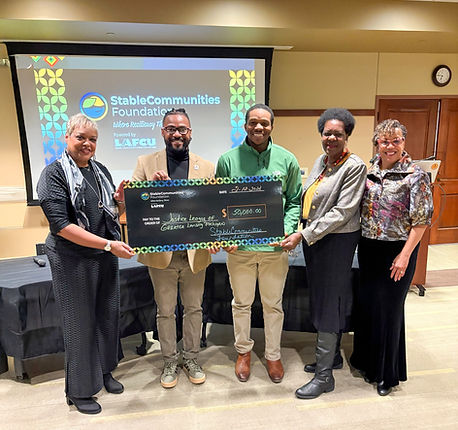
The StablesCommunities Foundation recognizes and supports the Justice League of Greater Lansing as a new grant recipient, honoring its impactful work in advocacy, empowerment, and community strengthening across Greater Lansing. With support powered by LAFCU, the foundation celebrates and invests in the organization’s continued efforts to create meaningful local impact.